
Agilent 7900 ICP-MS
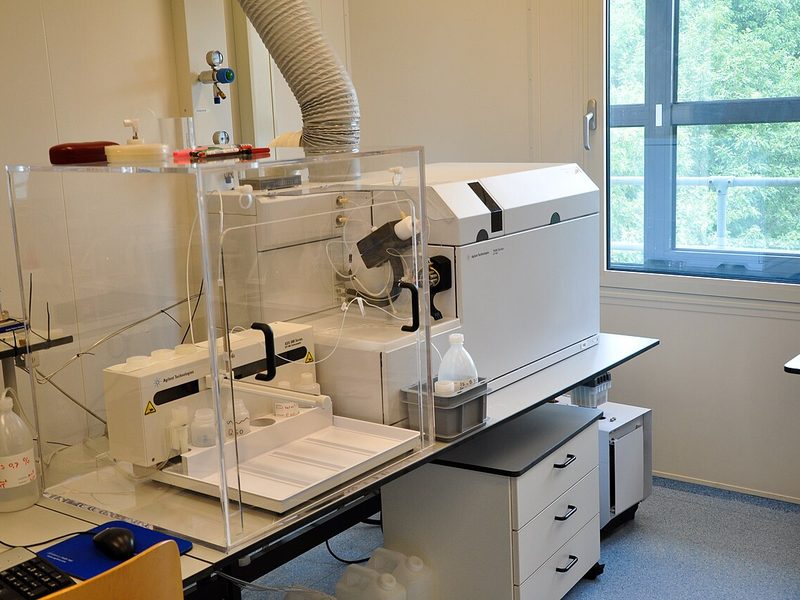
Trace and ultra-trace elemental analysis, including heavy metals.
Inductively coupled plasma mass spectrometry (ICP-MS) measures the elements in a sample rather than its molecules. The sample is converted to an aerosol and passed through an argon plasma at roughly 6,000 °C, which breaks it down into atoms and ionizes them; the mass spectrometer then counts the ions of each element. Most elements can be measured at parts-per-trillion levels in a single run.
At GMW Labs the 7900 is used for heavy metals and elemental impurity testing. Solid samples, including peptides and other finished products, are first digested in acid so that every element is in solution, and a helium collision cell removes the interferences that would otherwise inflate results for elements such as arsenic.
Applications
- Heavy metals: lead, cadmium, arsenic and mercury
- Elemental impurities following USP <232>/<233> and ICH Q3D
- Trace elements in water, soil, food and biological samples
- Elemental screening of peptides, supplements and raw materials
- Speciation work when coupled to our UHPLC
Typical Sample Types
Liquids and acid digests of solids. Powders, peptides and tissues are digested before analysis; typically 50–250 mg of solid is needed.
Key Specifications
| Technique | Inductively coupled plasma mass spectrometry (single quadrupole) |
|---|---|
| Interference removal | Octopole collision/reaction cell (helium mode) |
| Mass range | 2–260 u |
| Detection limits | Sub-ng/L (parts per trillion) for most elements |
| Sample introduction | Autosampler with Peltier-cooled spray chamber |
Specifications are provided for general reference. Method performance depends on sample matrix and project requirements.
To discuss a project that uses the Agilent 7900 ICP-MS, please call (314) 652-3448 or submit a project quote request.
Other Chromatography & Mass Spectrometry Equipment
- Agilent 7890B Gas Chromatography System
- Agilent 5977A Mass Selective Detector
- Thermo Scientific Dionex ICS-5000+ Ion Chromatography System
- Thermo Scientific Dionex UltiMate 3000 UHPLC System
- Thermo Scientific Dionex UltiMate 3000 Fluorescence Detector
- Thermo Scientific Q Exactive Plus Hybrid Quadrupole-Orbitrap Mass Spectrometer
- Elementar vario EL cube CHNS Elemental Analyzer
- Size-Exclusion Chromatography (SEC) Columns, Waters ACQUITY UPLC Protein BEH SEC 125 Å